
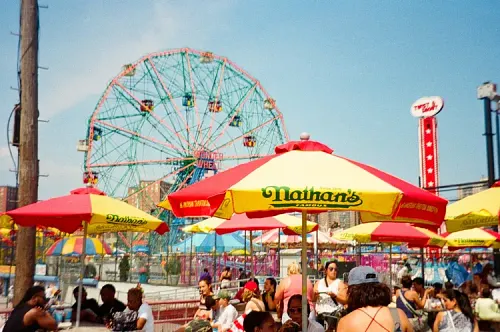
Can nostalgia be tangible? Something you can feel, touch, and remember through collective memory shaped by cultural visuals. Americanah offers ofa lens into an idealized, often false America filled with sun-kissed Sundays, snow cones dripping down wrists, and flags floating in the summer heat. In this piece, we explore how the American Dream manifests through visual language and how we’ve become blind to its presence.
The image of America is everywhere, yet almost invisible. It lives in denim ads, sitcom laugh tracks, school buses, and Fourth of July fireworks. These symbols form a visual shorthand for belonging and hope, repeated so often they begin to feel real. These visuals are the wallpaper of daily life, setting the stage for a promise of freedom, abundance, and belonging. Even outside the U.S., the same symbols spread through pop culture, shaping a shared fantasy.
But this dream of America is selective. It flattens differences and conceals contradictions. When reality doesn’t match the image, when injustice, exclusion, or inequality push through the cracks, we often fail to see it. The dream persists, unchallenged, because we no longer question the images we’ve inherited.
Through these photographs, we ask: What does this dream obscure? And can these images be reclaimed to reflect something truer, more human, and more just?




Build your own visual library
Playbook is a free, collaborative way to organize anything visual.
Try Playbook for freeCan nostalgia be tangible? Something you can feel, touch, and remember through collective memory shaped by cultural visuals. Americanah offers ofa lens into an idealized, often false America filled with sun-kissed Sundays, snow cones dripping down wrists, and flags floating in the summer heat. In this piece, we explore how the American Dream manifests through visual language and how we’ve become blind to its presence.
The image of America is everywhere, yet almost invisible. It lives in denim ads, sitcom laugh tracks, school buses, and Fourth of July fireworks. These symbols form a visual shorthand for belonging and hope, repeated so often they begin to feel real. These visuals are the wallpaper of daily life, setting the stage for a promise of freedom, abundance, and belonging. Even outside the U.S., the same symbols spread through pop culture, shaping a shared fantasy.
But this dream of America is selective. It flattens differences and conceals contradictions. When reality doesn’t match the image, when injustice, exclusion, or inequality push through the cracks, we often fail to see it. The dream persists, unchallenged, because we no longer question the images we’ve inherited.
Through these photographs, we ask: What does this dream obscure? And can these images be reclaimed to reflect something truer, more human, and more just?


