
TL;DR: Managing AI-generated assets means keeping the flood of generated images, variations, and edits findable, deduplicated, and traceable back to their source. Generation is nearly free now, so volume explodes and provenance blurs. Most tools help you make AI assets, not manage them. A working system does five things: dedup on upload, auto-tag every batch, stack variations into groups, record the prompt and source in custom fields, and attach rights and content credentials so you can prove where an image came from.
Something shifted in the last eighteen months. Making a usable image stopped being the hard part. You type a prompt, wait a few seconds, and you have ten options. Change one word, and you have ten more. Your designers do it. Your social team does it. Your agency does it, and sends you the winners plus the forty they discarded.
The result is a new kind of mess. Not the old problem of too few assets and no budget to shoot more. The opposite: too many assets, arriving faster than anyone can name, sort, or vet. Your library used to grow by the shoot. Now it grows by the prompt.
This is a guide to getting ahead of that. We will name the problem honestly, then teach a system for managing AI-generated assets that holds up whether you generate ten images a week or ten thousand.
What is AI-generated asset sprawl?
AI-generated asset sprawl is the uncontrolled accumulation of machine-made images, video, and edits that pile up faster than a team can organize, name, or trace them. It is what happens when the cost of creating a file drops to almost zero and nothing downstream changes to absorb the new volume.
The old library problem was scarcity. You had one hero shot and reused it everywhere. The new problem is abundance without order. A single campaign concept can spawn hundreds of files before a human picks one. A prompt returns a dozen usable variations in seconds, and most teams keep all of them "just in case."
Three things make this pile different from a normal backlog. The variations look nearly identical, so scanning thumbnails does not tell you which is final. The files carry no built-in record of the prompt or model that made them. And nobody decided, up front, which ones were cleared to publish. You are not short on assets. You are short on a way to make sense of them.
Why is managing AI-generated assets so hard in 2026?
Managing AI-generated assets is hard because generation removed every natural limit that used to keep libraries small and legible. When each new image cost a photographer, a location, and a day, volume policed itself. That brake is gone.
Three forces now work against you at once:
- Volume. The cost of one more variation is a keystroke. Teams generate in batches and rarely cull, so the library grows in bursts, not trickles. On Playbook's Free plan the ceiling is 300 assets or 100GB, a threshold a single afternoon of generating can approach, and paid storage overage is added automatically in 1TB blocks at $25 per month at the time of writing. Sprawl is a line item, not just a feeling.
- Sameness. Ten outputs of the same prompt differ by a shadow or a crop. Filenames like
image_final_v3_REAL.pngtell you nothing, and folder trees collapse under the near-duplicates. - Provenance blur. A generated image arrives with no memory of how it was made, what it was trained on, or whether it is safe to put on a billboard. That gap is a legal and brand risk, not a filing inconvenience.
The hardest part is that all three compound. More volume makes sameness worse, and sameness makes provenance harder to reconstruct after the fact.
Ready to get ahead of the flood instead of drowning in it? Schedule a demo and see a library that organizes itself.
Why don't AI generators solve the sprawl they create?
AI generation tools are built to produce assets, not to manage them, so the flood lands in your storage with no system attached. This is the honest gap in the 2026 stack, and it is worth stating plainly.
Midjourney, DALL-E, Firefly, and the rest are genuinely excellent at the moment of creation. That is the job they optimize, and they do it well. But the moment the download finishes, their responsibility ends. The output lands in a folder named "Downloads," with a machine-generated filename, no tags tied to your campaign, no link to its siblings, and no rights record.
Everything after that is a different discipline. Deduplicating the batch, describing each file so it is findable, stacking the variants so they stop cluttering the board, and recording where each one came from: none of that is what a generator is for. The tools that help you make AI assets were never designed to help you manage the flood. That management layer is the whitespace, and it is where a real asset system earns its keep.
What does a system for managing AI-generated assets look like?

A system for managing AI-generated assets rests on five principles: deduplicate on intake, make every file findable by content, group the variations, capture provenance as structured data, and make the whole thing run without willpower. Get these five right and volume stops being a threat.
- Deduplicate on intake. Identical files should merge before they ever cost you storage or attention. Re-imports and copied-across-boards assets are the quiet majority of sprawl.
- Make every generation findable by content, not filename. If search reads the pixels, an untagged batch is still discoverable the moment it lands. If search reads filenames, the batch is invisible.
- Stack variations, do not scatter them. Ten takes of one concept belong in one tidy stack with the chosen version on top, not spread across a board as ten separate tiles.
- Record the prompt and source as data on the file. The prompt, the model, the human who approved it, and the rights status should travel with the asset, not live in a side spreadsheet that drifts away from the work.
- Attach rights and content credentials to the file itself. Provenance you can prove later, using an open standard like C2PA and Content Credentials, turns "is this cleared?" from a panic into a lookup.
The last principle underneath all of these: it has to be automatic. A system that depends on a busy designer remembering to tag is a system that fails by Friday. The filing should happen the moment a file lands, or it will not happen at all.
How does Playbook tame AI asset sprawl?
Playbook is a digital asset management and creative workflow platform that applies all five principles to AI-generated assets inside a single library. It is not a generator with storage bolted on, and not an archive with a search bar. The unit of work is creative in motion: generate, organize, review, and share in one place.
Here is how each principle maps to something you can turn on.
Dedup on upload. The moment files land, Playbook fingerprints each one by content, not filename, and merges byte-identical duplicates automatically, so you never pay to store the same generation twice. Copies across boards reference the same underlying file and consume no extra storage. Playbook even surfaces the storage saved through automatic deduplication per workspace. This is the first line of defense against a batch of near-identical outputs, and it runs in the background on smart, visual storage.
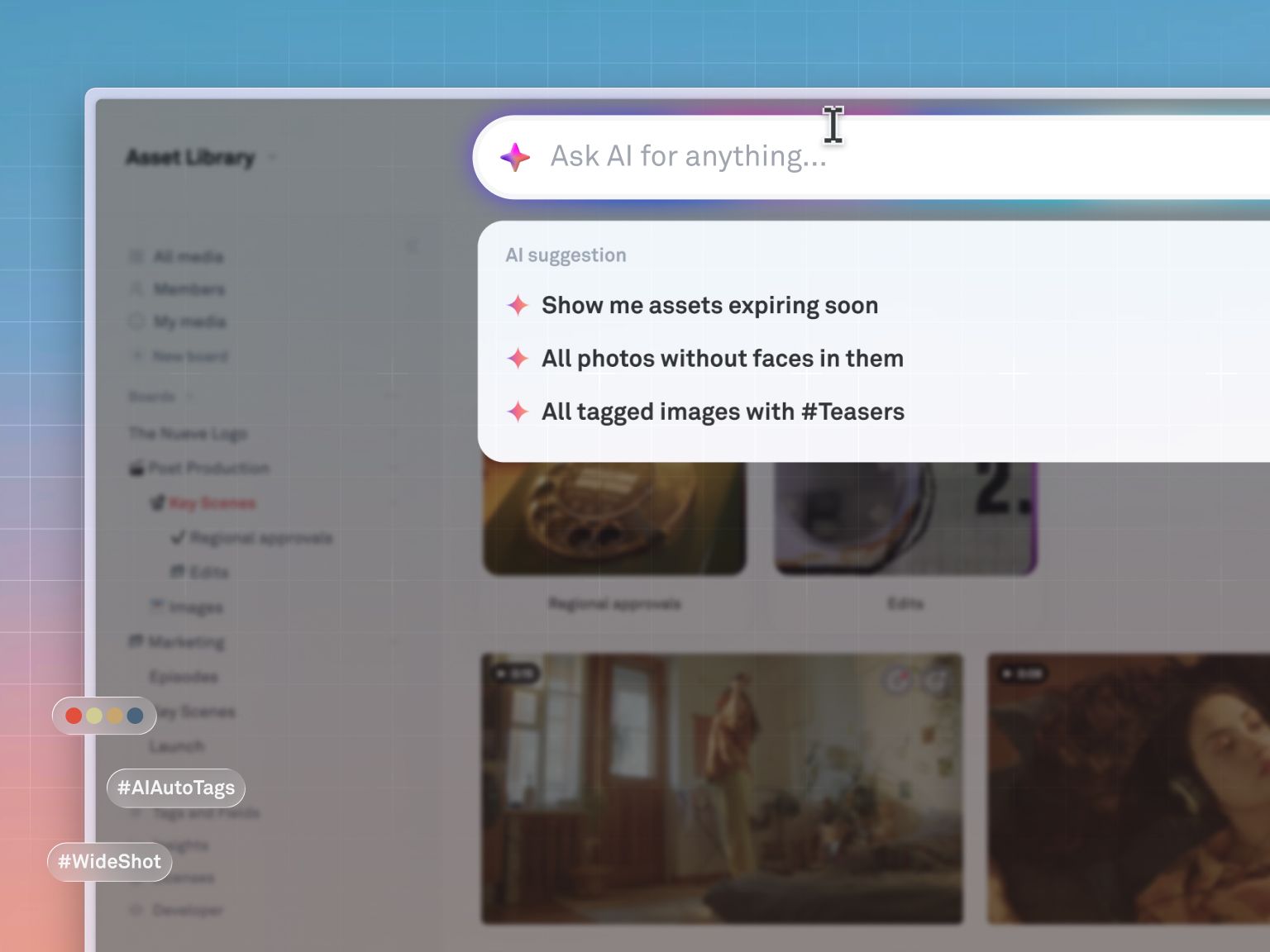
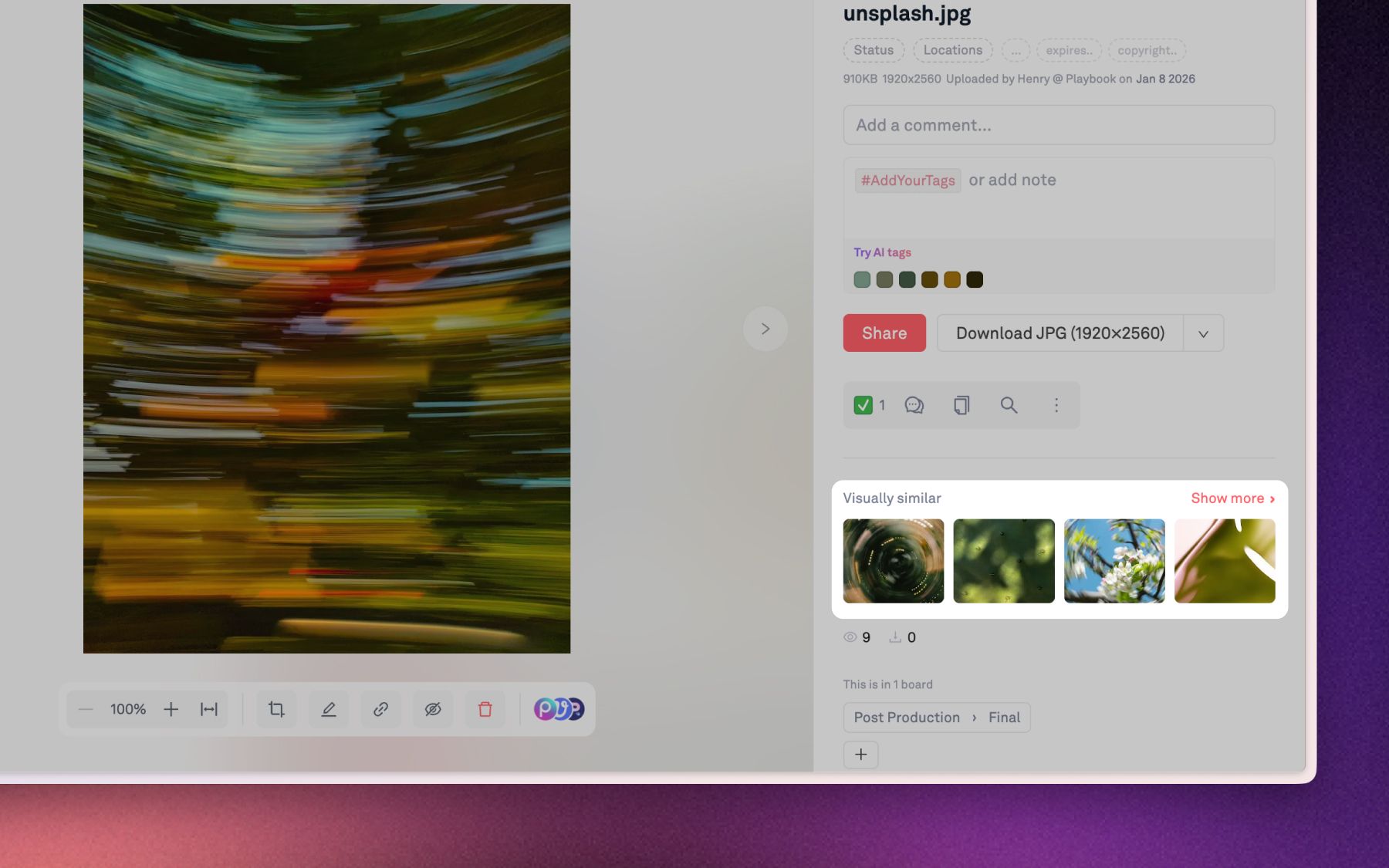
AI tags make generated batches findable. The moment an asset lands, Playbook reads the actual content and tags every image and video across 16+ dimensions, including visual style, color palette, campaign, product, and usage rights. An untagged batch of AI outputs becomes searchable the instant it finishes processing, so you can pull up every file you meant to keep by describing it rather than remembering where it went. This is the difference between a library that grows and a library that decays. Wilderdog, an outdoor dog-gear brand with a 400k-strong Instagram following, centralized more than 20,000 assets and set board rules to tag content from 30+ creator partners automatically. "Playbook has made it much easier to quickly find the content I need," says co-founder Rachel Friedline. See how it works with GPT-powered smart search.
Groups stack the variations. Drag one output onto another, or multi-select and group, and ten takes of a concept collapse into one clean tile with the final on top and the alternates tucked underneath. The board reads clearly without anyone deleting the runners-up, which matters when the whole point of generating was to keep options open.
Custom fields track the prompt and the source. Attach structured, typed metadata to every asset: a Status like Draft or Approved, the model used, the prompt, the campaign, and a rights state. Because Playbook indexes those fields, they double as filters, so "show me every approved, cleared, Midjourney-sourced hero image for the spring launch" is a query, not an archaeology dig. The file carries the workflow instead of a spreadsheet.
Rights and content credentials give you provenance. Playbook lets you record usage terms and copyright on an asset, generate a license PDF for a specific client and date range, and issue content credentials, invisible authorship certificates powered by the Mentaport partner, that mark an image's origin. For AI-generated work, that provenance layer is not a nicety. It is how you answer, months later, whether a given image is safe to reuse. It builds on the same open provenance standards backed by the Content Authenticity Initiative.
And you can generate inside the same library. Playbook's own AI image generation means new assets are born into a managed home, already deduplicated, tagged, and groupable, instead of landing in a Downloads folder to be sorted later. Managing the flood is easier when the flood starts inside the system, part of the Playbook Intelligence suite.
The proof is in the volume teams are already running this way. Outdoor Living Today, a consumer brand selling cedar outdoor structures, migrated a 1TB library and now manages more than 33,000 product photos, videos, and renders in Playbook. "The platform is fluid, easy to work within," says Marketing Manager Austin Gray. Across its base, Playbook reports that 96% of users spend less time hunting for files after switching. That number goes up, not down, as generation volume climbs.
The taming AI sprawl checklist
Save this and run it against your own library. If you cannot check all seven, you have found where the flood is getting in.
- Dedup on upload. Identical files merge automatically before they cost you storage.
- Auto-tag every generation. New assets are searchable by content the moment they land, no manual labeling.
- Stack variations into groups. Ten takes become one tile, alternates preserved and out of the way.
- Record the prompt and source. Model, prompt, and approver live on the file as custom fields you can filter.
- Set a rights and content-credential state. Every asset carries whether it is cleared to publish and where it came from.
- Make one board rule do the work. Set tagging and status rules once so intake organizes itself.
- Archive dead variations. The runners-up you will never use stop counting against your billable total.
Frequently asked questions
What does "managing AI-generated assets" actually mean?
It means keeping generated images, video, and edits organized, deduplicated, findable, and traceable to their source as volume scales. In practice that is five habits: merge duplicates on intake, auto-tag by content, group variations, store the prompt and rights as metadata, and attach provenance so any file can be verified later.
How do I organize AI generated images without tagging every one by hand?
Use a system that reads the image itself. Playbook auto-tags each asset across 16+ dimensions on upload, so a batch is searchable by subject, style, and color the moment it processes. Board rules apply your tags and statuses automatically to anything dropped in, which means intake organizes itself instead of waiting on a person.
What is the best way to handle too many AI variations of one concept?
Group them. Stacking related outputs into a single tile, with the chosen version on top and the rest tucked underneath, keeps every option one click away while a board stays readable. It is display and organization, not deletion, so you keep your alternates without the clutter of ten near-identical thumbnails.
Do I need version control for AI images?
You need traceability more than classic version control. Record the prompt, model, and approval status as custom fields on each asset, stack iterations into groups, and keep a rights state on the file. That gives you a clear answer to "which one is final and is it cleared?" without a separate document tracking it.
How does provenance work for AI-generated assets?
Provenance ties an origin record to the file so you can prove where an image came from. Playbook records usage terms and copyright, generates license PDFs, and issues content credentials via the Mentaport partner, aligned with open standards like C2PA. For AI work, that record is how you verify months later whether an asset is safe to reuse.
Stop managing the flood by hand. Playbook deduplicates, tags, groups, and traces your AI-generated assets in one library, so volume stops being a liability. Schedule a demo.